
Graphic: Amarrah Amaral-Deluca / LANCE
After weeks of frustration from students whose bus pass opt-out requests were denied, the University of Windsor Students’ Alliance (UWSA) has approved additional opt-outs for the 2026-27 academic year.
The decision has reopened a debate about student affordability, public transit funding, and how student voices shape campus services.
Introduced in 2016, the Universal Bus Pass (U-Pass) program provides unlimited Transit Windsor rides to students through a mandatory ancillary fee included in their tuition.
This year, the U-Pass cost $316.48 for first-, second-, and third-year undergraduate students, and $203.14 for fourth-year students.
Earlier this month, many students who tried to opt out of the program received emails from the UWSA informing them that their request had been denied, even if they lived outside of the Transit Windsor service area or had already paid for a parking pass.
“I feel helpless every year when I spend my time trying to opt-out, but continue to be rejected despite not having any purpose for this bus pass at all,” fourth-year communication, media and film student Marie Piechutta told the Lance.
Second-year education student Denise Alford has similarly been unable to opt out of the program since she started university in 2021.
“It should be something you opt into instead of opting out of,” she said.
Piechutta and Alford are not alone in facing repeated denials.
On Oct. 21, students created a Change.org petition calling for greater transparency from the UWSA, changes to the opt-out process, and revisions to — or the complete termination of — the U-Pass program.
The petition has since garnered over 1,400 signatures.
At their over five-hour-long meeting on Oct. 27, the UWSA board of directors reviewed financial projections and approved a motion allowing for more students to opt out beyond the 25% cap.
Beginning Nov. 9, students approved for a refund can collect their cheques from the UWSA offices.
The additional opt-outs are a one-time accommodation for the year; the UWSA has indicated that making similar accommodations in the future will require further discussion and financial considerations.
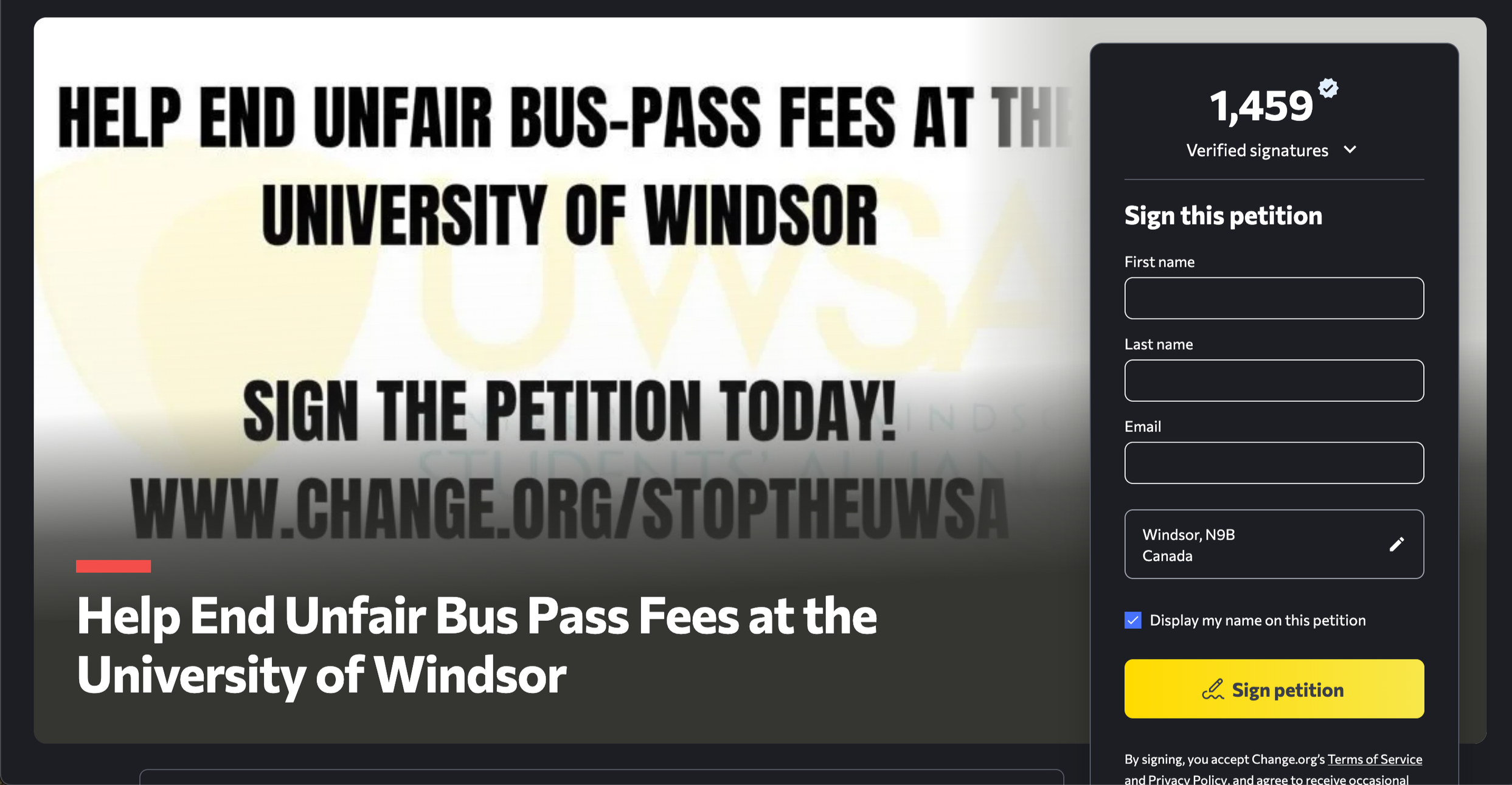
“[The U-Pass program] is a direct assault on our consumer rights, and it mirrors an authoritarian approach unworthy of an institution that promises to uphold fairness and student welfare, calling themselves a ‘Student Alliance,’” writes the creators of the Change.org petition.
President Victorieuse Sambao told the Lance that the UWSA have been working behind the scenes for months to find solutions for students who would not need the transit pass.
Students who want to see long-term changes to the program, she said, should continue making their voices heard through student governance processes, and supported the possibility of a referendum.
“The biggest and most powerful movement is that the students do a referendum,” said Sambao. “I fully support a referendum being done.”
Following a three-year pilot, students voted in a 2019 referendum to continue the U-Pass program. That agreement between the three student associations and Transit Windsor governs how the program operates.
While the student petition suggests the UWSA benefits directly from the U-Pass, budget documents from the City of Windsor indicate that Transit Windsor collects the revenue funds. The UWSA meanwhile recieves a 2 per cent commission for administering the program.
In an e-mailed statement to the Lance, Transit Windsor said that the U-Pass is intended to provide students with accessible transportation while creating a predictable and sustainable foundation for transit service.
They also noted that while the U-Pass agreement establishes the overall framework for the program, including the maximum 25 per cent opt-out provision, individual opt-out applications and eligibility decisions are administered by the student associations.
Transit Windsor said it values its ongoing partnership with UWindsor’s student associations and remains committed to working with them to support students’ needs while maintaining an accessible and sustainable U-Pass program.