
Cows like Salty Popsicles
“Vertebrate with a T, I don’t look at bugs!” laughingly exclaimed Marissa Mowers. This third-year forensics student found her place by specializing in life sciences and applying to the Outstanding Scholar’s program.
Fascinated by Dr. Shari Forbes’s research on taphonomy, the study of what happens between death and the discovery of remains, forensic anthropology became Marissa’s dream field. This dream quickly became reality when in year one of her degree, she discovered the Outstanding Scholar’s Program, a paid-research position, and got the job.
One of her two main projects has been two and a half years of scavenging trials, observing the vertebrate of scavengers like coyotes and turkey vultures, and uncovering how they feed on remains. They use pigs for the research to replicate human remains since our body fat is most similar to these barn animals. Mowers even dresses the pig in human clothing, thrifting from second-hand stores, to discover what animals do with the clothes whether it be tearing it off, gnawing on it, or leaving it still. The pigs that are donated from farmers are already unhealthy, sickly, or dead to keep in ethical practices. Still a life to help with research, Mowers always lays the lifeless animal in a natural and comfortable position for their final spot to rest. “It’s my way of saying thank you for helping us in the research.”
By setting up motion cameras on the trial sites, much information is captured.
“Just like dogs, we learned coyotes want to run away and eat a limb by themselves. Therefore, if you can’t find all the remains, increase your search radius. Our findings also help the law enforcement immensely.”
Most of the professors from the department are consultants for the police to help with investigations and autopsies. Having forensic anthropologists and forensic chemists on site can speed up the investigation and uncover vital evidence.
Thousands of pictures go to their laptops. The students must sort through grass blowing in the wind or a bug triggering the sensor and then analyze the feeding pattern. Experts on Excel spreadsheets then note the animal’s and feeding time, make a graph, analyze the pattern, and draw conclusions.
“Coyotes are very intelligent creatures and can sense where the cameras are, suddenly there is a coyote staring dead at the camera. Talk about a jump scare.”
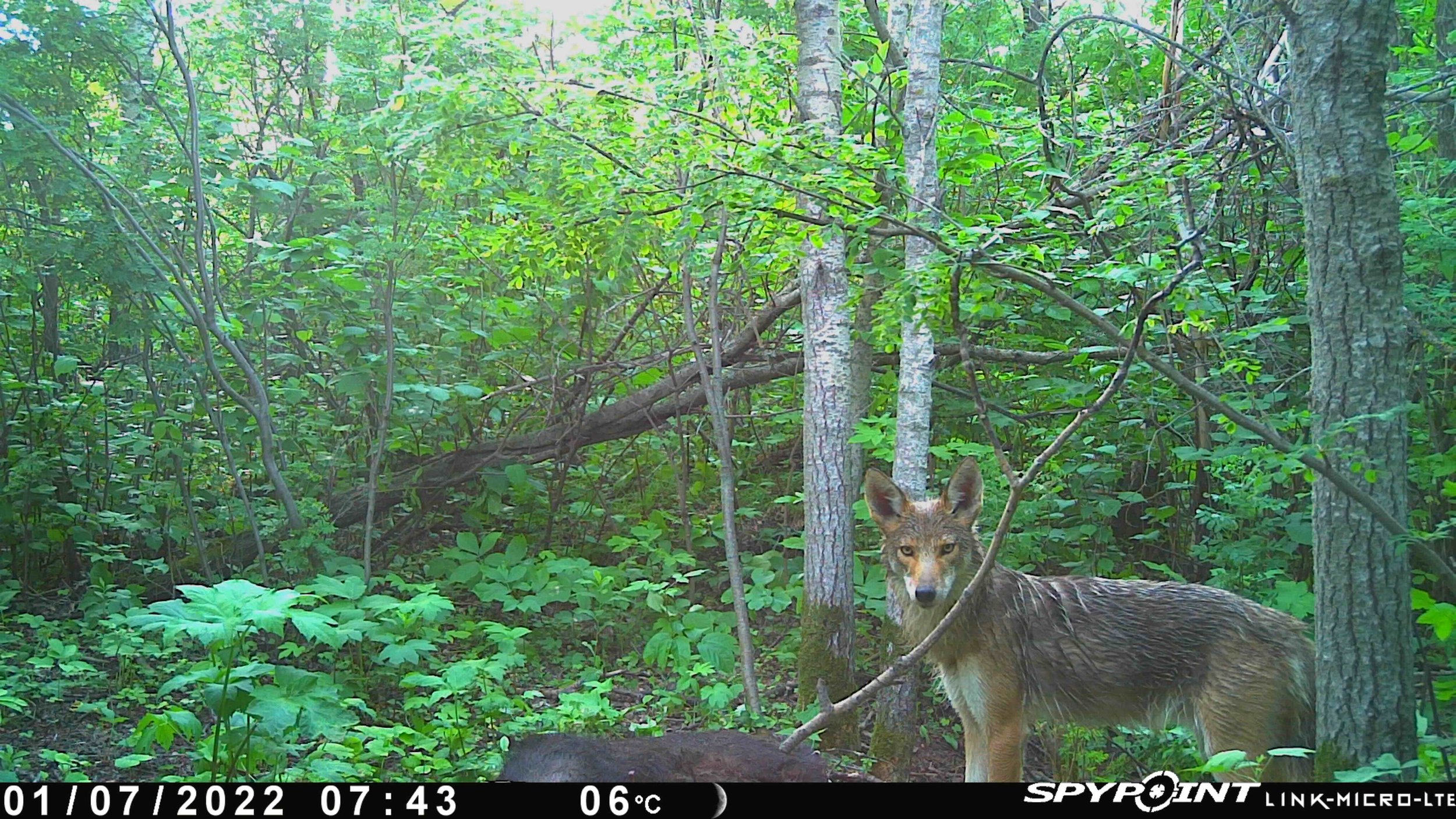
Coyote from Saskatchewan site, taken by motion camera.
Just like pig remains are most similar to human body fat, the skeletal remains of deer are most similar to human bones. Deers for research purposes come from an unfortunate fate—roadkill. Mower, immune to the horrific scene, gets personal calls from the City of Windsor. An established relationship through roadkill? How romantic! She gets her very own brother to help load the deceased deer into her truck.
Her professors stressed the importance of seeking mental health support if the images are ever harrowing. It is not uncommon to get nightmares from a research site, students are advised not to push the horrific scenes down, but instead, talk to a therapist.
They have many research sites as the environment affects the research and so do the different types of animals. The environment can be closed, such as protected by trees, or open like a field. A closed environment has been proven busier as the animals feel safer to eat.
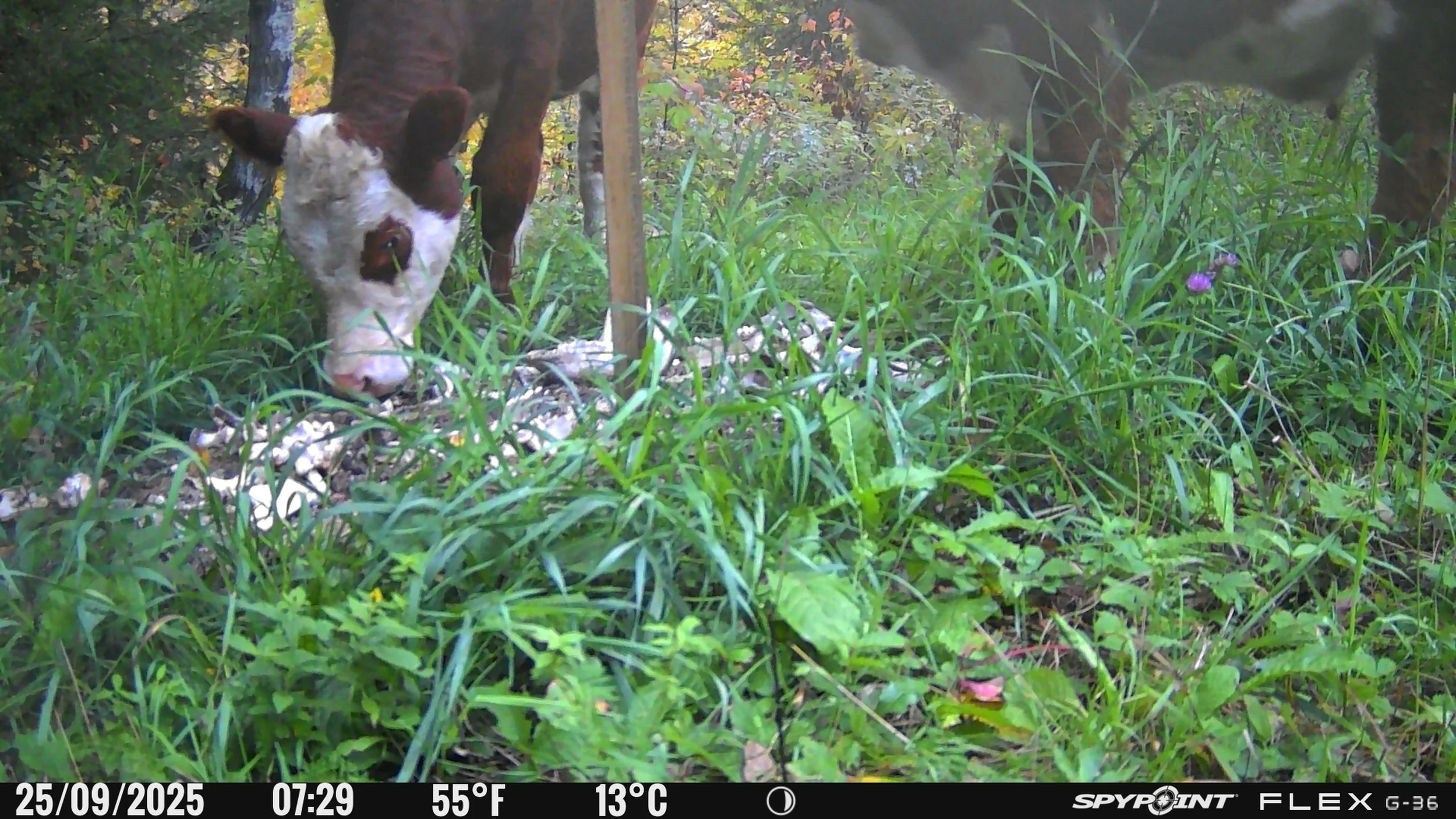
“On one of our most recent projects, several cows had wandered from a nearby farm onto our research site in North Bay Ontario. The pig was already skeletal, and the cows were just licking them! They’re cows, they’re herbivores! We learned cows and deer will lick bones as salt licks to get minerals from them. That was so cool!”
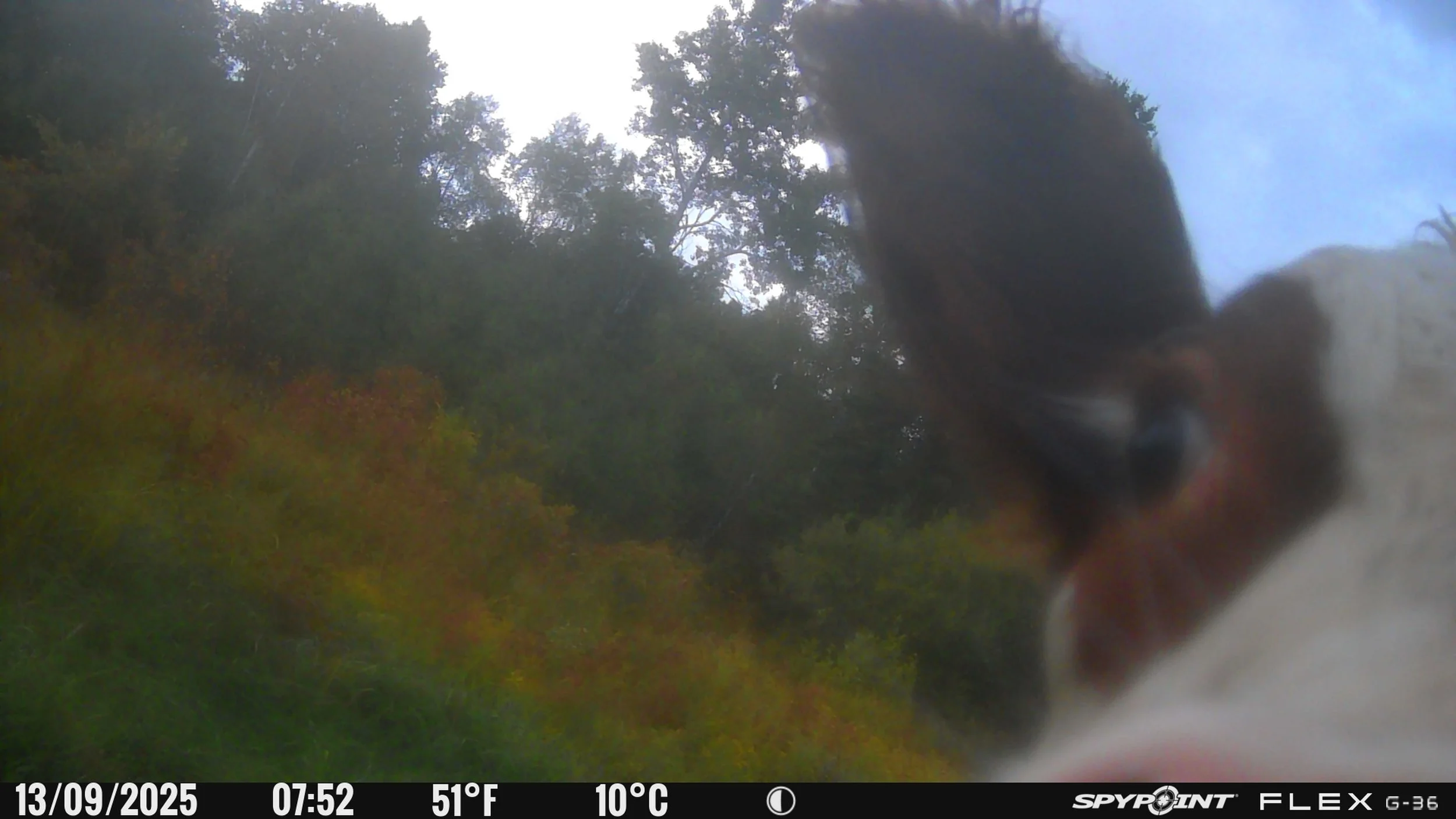
Cow from North Bay site, taken by motion camera.
Her second and independent project delves deeper into the ground, past death and into the grave, using ground penetrating radar (GPR). Wanting to go into decomposition, skeletal remains, search and recovery, she added archaeology and excavating remains to her ambitious list of pursuits.
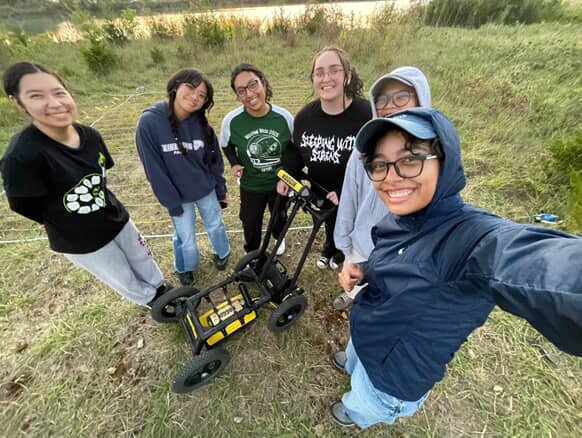
From left to right: Christina Castelblanco, Lauren Amizola, Julie Hernandez, Marissa Mowers, Abigail Lam, and Ximena Alfaro-Grande using the GPR.
Dr. Maria Cioppa, a geophysicist uses GPR to locate burials that aren’t marked. Specifically searching for Indigenous Peoples who did not get the opportunity of a dignified burial. Before performing an archaeological excavation, the GPR can detect old cemeteries to know what spots are filled or empty. Although it is a great tool to have, just like any technological machine, they are not perfect. GPR has a hard time differentiating rock from bone.
This can be a problem in real forensic investigations especially when the human labour of digging can be strenuous. Sometimes clay messes with the radar because it’s so moist and dense, it absorbs the signal. Bone mass will also become smaller as the years pass. With no reliable research to find a way to improve finding skeletal remains, Mowers wanted to do something about it.
“First, I’m going to try and calculate the dielectric constant from the radar scan. These values vary with moisture content and materials and might differ so slightly between rock and bone that it’s not a reliable measure of differentiation. The second method I’m going to attempt is the shape of reflection itself on the scan, its width, amplitude, and other characteristics that might help differentiate signals from buried rock from buried deer bone.”
Mowers’s striking vigour continues to shine as she works at completing the manuscript and laying out the data collected from the Saskatchewan trial, earning her a first-author publication. These research papers are huge gains and leaps forward to help the development and knowledge in forensic science for the future. We are proud to have Mowers as a Lancer. Her enthusiasm and intelligence will propel her forward at an exceptional rate.