
Our Literacy Crisis
Cover photo by Archon Shadow
Kid’s education is failing, and nobody is working to fix it. Children have screens shoved into their hands before they can even read, and the effects are starting to show. However, the first step to reformation is to enlighten yourselves to the harsh truth.
Take a look at New Brunswick’s literacy levels for grade four students. The auditor general found that only four of the 130 Anglophone schools had reached the reading objective, a shocking result to say the least. Additionally, in 2022 it was discovered that only 60% of the second and fourth grade students have met the required reading levels, a heavy decrease from the 84% spike recorded in 2010. As if that’s not bad enough, in Ontario, the portion of children who are able to comprehend the literature they read and utilize several sources of information sits at 13%.
However, why is this happening? There are several possible sources to blame, such as the excessive screen time that children are permitted by their parents, the lingering effects of the Covid-19 pandemic, and decreased passion for learning. According to Statistics Canada, children aged 11 to 18 have an average of 7.8 hours a day of screen time, while the recommended limit rests at 2 hours. Unrestricted internet use alone has consistently harmed children’s sleep patterns along with their vocabulary and grammar scores. It has also been correlated with the diminishing of attentions spans, a critically important tool for childhood development. The issue with prolonged device usage can be traced back to the pandemic lockdown when parents were forced to buy electronics for their kid’s education, effectively getting them hooked on the digital world when they were supposed to be learning how to multiply. Early addiction compounded with a lack of parental supervision leads to the detrimental results we see before us. The recent pandemic also created large gaps in learning for many children as they lacked a stable classroom environment where their focus was monitored. Many kids fell behind under the lack of supervision and have never been able to recover.
These consequences do not work alone. They amalgamate and grow until a child, so full of potential, becomes reduced to a screen-addicted zombie who will depend on AI to think.
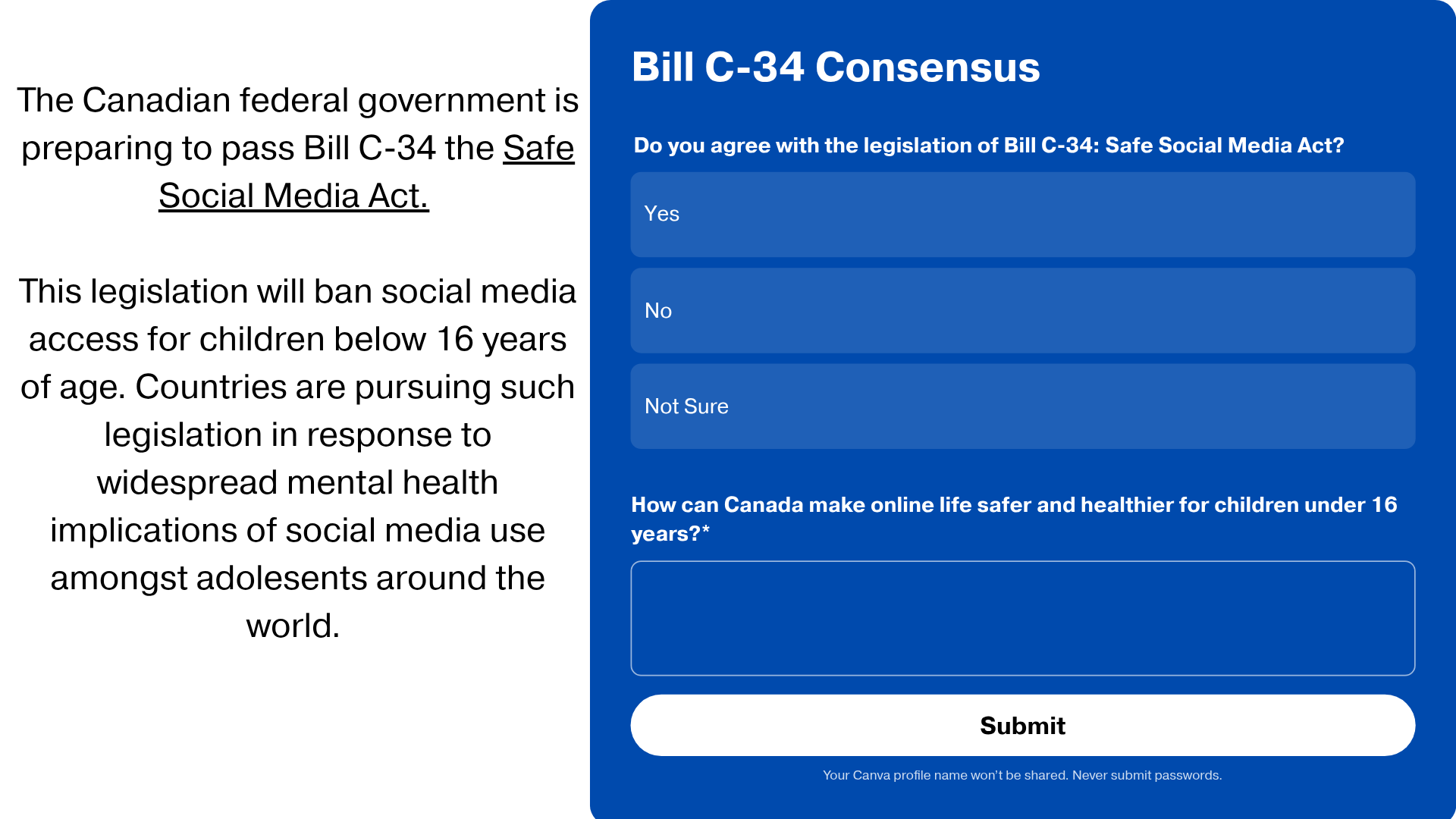
Fill out our consensus form for Bill C-34 The Safe Social Media Act
Furthermore, after the crucial development periods in a kid’s life have passed, it is near impossible to get them to read recreationally. Everyone used to love stopping by the library to grab the next book in your favourite series but now those buildings are deserted. This abandonment can be attributed to the frustration they experience when they are unable to comprehend the texts before them, even if those pages are meant to be at their reading level. Once that frustration sets in, they lose interest. Moreover, many schools enforce an unsteady reading schedule which includes large breaks where the students analyze and dissect the texts. While this is important for their understanding, this does not effectively enforce the fluid motions of reading which allows the student to truly enter the world and follow the story. Instead, they absent mindedly search for quotes and 5 “difficult words” to define.
The passion component of reading is so important as it has been proven that children who read recreationally improve more in spelling, vocabulary and maths while also having better focus, critical thinking, and memory.
This problem is deeply embedded into our current school environment, but people can still fix it. To repair this damage, I believe that Canadian schools should more harshly enforce their ability to hold children back a grade. While parents are rightfully cautious against the idea for fear of their child’s socialization, I think it is a necessary intervention. Not only does this allow a truly desperate teacher the ability to continue their progress with an underachieving child, but the mere mention of it also provides motivation for a parent to become more involved. Whether that means hiring a tutor to get them up to speed, letting their kid stay after school for homework help, or even taking some time to coach them themselves.
These options do not all require money if that is the parental concern, as most high school students are required to gain 40 volunteer hours to graduate. Many of those hours come from offering free tutoring to local schools or even one-on-one. If the child still does not improve enough to constitute their academic promotion, then I strictly reaffirm that they should remain in their current grade. Their social promotion and the dilemmas that come in its absence are insignificant against the potential repercussions.
In order for the next generation to become successful contributors to our society, they need to be able to think critically, and act in a way befitting their education. This means that instructors and board members of schools alike must work together to manage the challenges brought upon by forces beyond their control.