
Not like the movies: inside UWindsor’s Greek life

There’s a certain image that comes to mind when the words “sorority” or “fraternity” are mentioned.
Maybe that image is something out of a movie: big houses on campus, hundreds of students, parties, drinking — or maybe it’s hazing scandals, discrimination, and concerns over gender-based violence.
For some, Greek life can seem like something exclusive to American colleges. But Greek life is alive and well at the University of Windsor, and it looks a little different.
The Delta Zeta sorority is part of the Omicron Nu chapter, the only chapter located in Canada. Others can be found across the United States, from Michigan to California.
The UWindsor chapter was established in 1992 and would continue Delta Zeta’s legacy of “lifelong sisterhood, leadership and service” for over 30 years.
For President of Membership Haileigh Prinselaar, her message to prospective members is simple: “Don’t believe the movies.”
“I think there’s always this stigma that [sororities are] all blonde girls and we get that all the time,” said Prinselaar. “Delta Z is very diverse and welcoming to anyone.”
While public recruitment events have ended, there are opportunities for one-on-one coffee dates with members. From there, they host invite-only events and “bid day” where students are officially invited to join the chapter.
According to their mission statement, Delta Zeta’s vision is “to be a global women’s organization whose shared values truly inspire action and impact lives.”
UWindsor’s chapter works closely with charities like the Starkey Hearing Foundation, which provides hearing aids for people in need; the American Society for Deaf Children; and SeriousFun, a network of accessible summer camp experiences for children with disabilities and their siblings.
Locally, the chapter works with the Katelyn Bedard Bone Marrow Association, an organization that raises awareness about the need for bone marrow donors, encourages people to join the registry, and provides financial support to patients undergoing transplants.
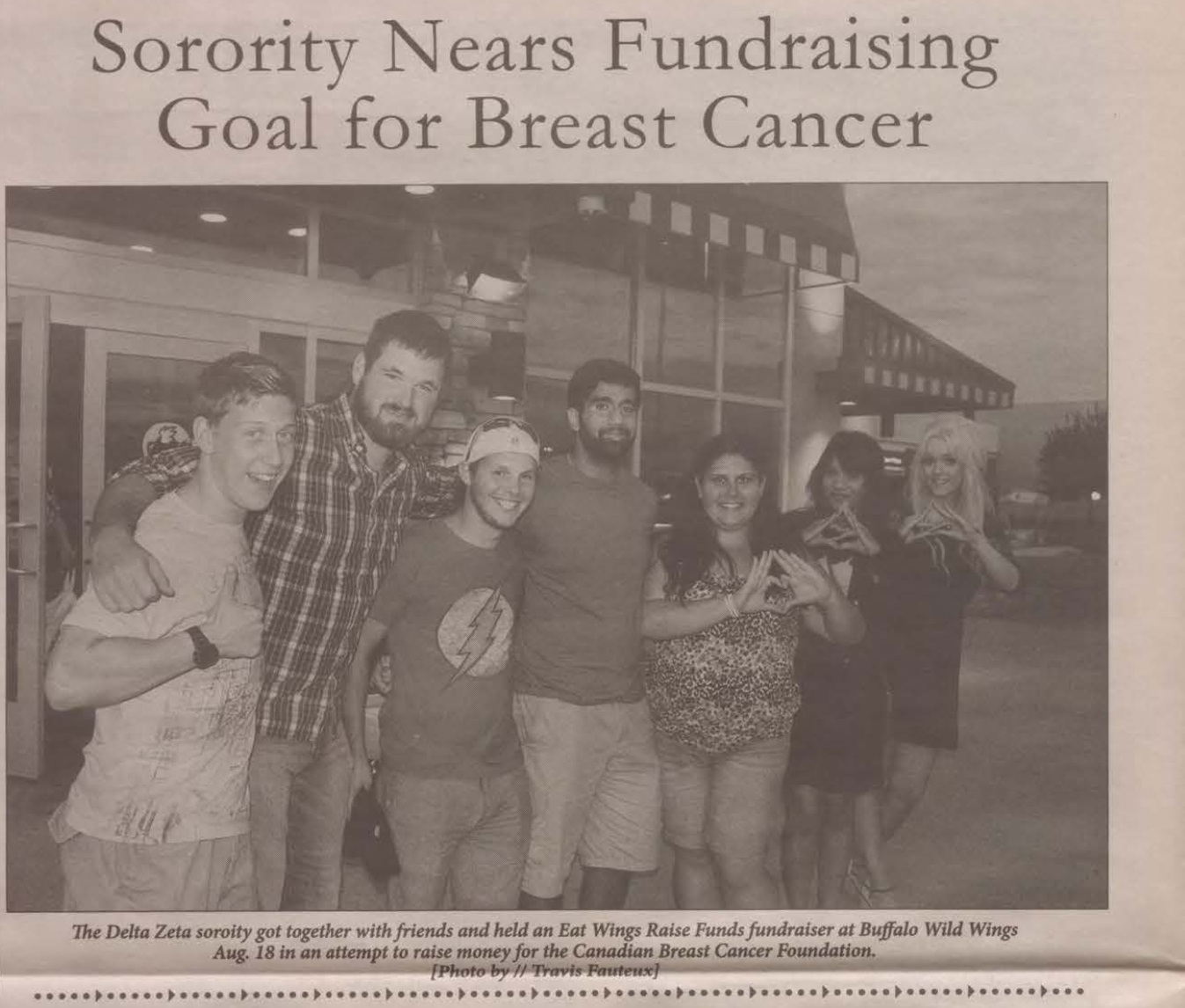
Members of the Delta Zeta sorority and their friends are pictured in the Aug. 28, 2014 issue of the Lance fundraising for the Canadian Breast Cancer Foundation.
| Photo: Leddy Library Archives, Lance School Year 2014-2015
New members learn the foundations of Delta Zeta and what it means to be in a sorority in the first semester. From there, they become “active” or fully initiated members with promises of sisterhood, friendship, leadership, and travel opportunities.
Members who decide not to join often make friends along the way through the recruitment process, campus events, and community.
In addition to Delta Zeta, UWindsor has two other Greek life chapters: Delta Alpha Theta, a sorority founded in 2005, and the Kappa Mu chapter of Sigma Chi established in 1994.
At the end of the year, the three chapters collectively host “Greek Week,” a week of events including a canned food drive, photo scavenger hunt, relay, and movie nights. The chapters compete to see who does it best.
The week provides some much-needed fun and relaxation before exams, in addition to allowing members to connect with other chapters.
“Friendship, belonging, generosity, and curiosity are things that we really stand on,” said Prinselaar, who shared her experience joining Delta Zeta in her first year after moving from Thunder Bay.
“I didn’t know anyone, it was just finding people that I could bond with.”
For students like Prinselaar, sororities offer a community for women to gain friendships, leadership opportunities, and a place they can come back to long after they graduate.
Today, Delta Zeta has approximately 15 members with hopes of reaching 40 by the end of December.
“Don’t be shy! You can meet our sorority [or] the other sorority, see what’s best for you and go from there,” Prinselaar said.
“If people are curious, reach out and ask questions. I love answering them.”