
Caring About Academics in the World of Academia: A deeper look at the people that give us our future
Welcome to the world of free lectures on the UWindsor campus that students choose not to attend unless incentivized with bonus marks. We happen to be living in it, and I want out. We all understand the struggle of making it to the end of your academic day, sauntering on home, and turning your brain off. What if you could hold out on that for just an hour, or maybe two? Instead of rushing off home, you stick around the UWindsor campus and attend a free-to-the-public talk that is put on by an interdisciplinary council that supports the humanities, a field of study that is increasingly disregarded by society despite its growing relevance.
It’s important to remember the passion behind academics. With professors, it’s easy to see them as two-dimensional beings: robots that talk at you for an hour or three, then shut off. You can see them in their office, or perhaps catch a glimpse of them in the halls of their department. But eventually it gets to a point where you realize that you’ve been fusing this person with their discipline. Seeing their area of study as a hallmark of their personality.
Yes, it’s true, your professor spent years becoming an expert in their field, but I think a lot of students forget that their professors are people with passions, and they’re multidimensional as well. What if we saw academics as people who love what they teach, instead of someone getting paid to lecture about something?
Us students have those opportunities presented to us on silver platters—to listen to an academic or a professor beyond the classroom.
The HRG (Humanities Research Group) is an interdisciplinary council that hosts free-to-the-public lectures surrounding the humanities, and provides the campus body with many opportunities to see our campus faculty in a more intimate light.
As per the group’s statement on the UWindsor website:
“The Humanities Research Group is an interdisciplinary council comprised of University of Windsor faculty, students, staff, and community members, who support humanities research and facilitate events where thinkers and audience members grapple with issues relating to the human condition.” (taken from https://www.uwindsor.ca/humanities-research-group/320/about)

(Pictured: Logo for the University of Windsor’s Humanities Research Group)
The group hosts free lectures, inviting field professionals to present their work or experience on a myriad of topics within the humanities to whoever is curious enough to listen. Chances are, anyone who has wandered through the halls of any UWindsor-affiliated building has seen their signature black and blue posters pinned to a bulletin board, inviting one and all to listen in on the expertise of these erudite individuals.
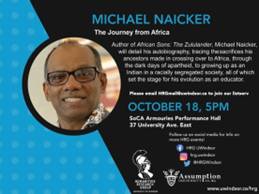
Pictured: Michael Naicker from his HRG event on the 18th of October 2025.
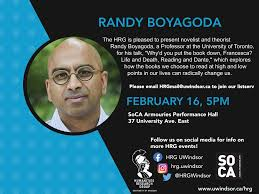
Pictured: Randy Boyagoda from his HRG event on the 16th of February.
One of these talks took place on March 19th, 2026, with the 2025-2026 Humanities Research Fellow Dr. Carlo Handy Charles.
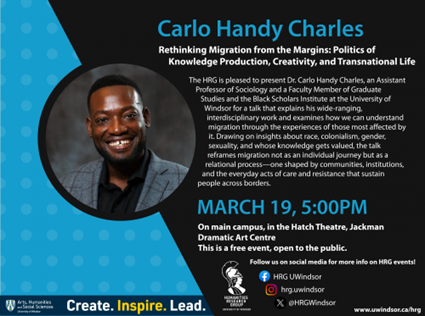
(Pictured: HRG event poster, Carlo Handy Charles)
Dr. Charles’ field of research is rather niche. How often does the average person have the opportunity to delve into such a specific topic by an academic who has studied and contributed to this field? This talk was one of many that has taken place on campus, free of charge. They are all excellent opportunities to learn about something new and meet other people who can match your curiosity.
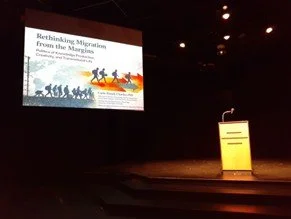
(Pictured: The podium and title slide of Dr. Charles’ presentation, which took place in the Hatch Theatre in the Jackman Dramatic Art Centre)
These lectures put on by the HRG are just one aspect of the opportunities at UWindsor. This institution has a lot to offer. When attending a post-secondary institution, it’s important to realize that for many, it’s the last opportunity to build strong relationships, whether with fellow students or faculty. For many adults, their closest friends are the people they met in college or university. I implore readers to take advantage of the opportunities offered while in post-secondary. You don’t know who you’ll meet, you don’t know what you’ll learn.
I’m not here to make orders, to make readers come to a specific conclusion. The entire function of higher education is to train students to think critically about the information they receive, the world in which they live. One way to do so is to ask questions that challenge their own way of thinking.
So, what is there to lose in learning something new? In sharpening your lens at a niche subject someone has spent years studying? Or, perhaps gaining a sharper understanding of a person that was lucky enough to discover a topic for the first time, fall in love with it, and decide to be associated with it for the rest of their academic career?