
The Greatest Invention faces the Greatest Challenges
If you put a human on a bicycle, they become the most efficient animal on the planet. All you need is a seat, two wheels, a chain, and the will to go forwards. No gasoline with its volatile prices or electricity with its controversial sources. Only a pure mechanism gifted with innocence courtesy of human ingenuity.
Origin of bicycle
The earliest designs of the modern bicycle date back to the late 19th century. Initially based off a peddling system that was directly attached to the front wheel, cyclists would struggle to achieve efficiency through effort. In 1869, innovator Penny Farthing tackled the challenge of distance travelled per pedal rotation by incorporating a large front wheel. Although visually humorous, this solved the challenge of cyclists having to peddle relentlessly to achieve faster speeds. One pedal rotation would equate to a much larger circumference given the larger front wheel. Ultimately, the distance traveled per peddle increased drastically. However, this design left riders struggling to balance themselves on a high seat placement and subjected them to injuries from higher falls.
This idea was eventually scrapped and replaced by adapting the legendary Leonardo da Vinci’s illustration of the chain drive. Initially conceptualized by Su Song in 1092 for the use in astronomy clocks, the chain drive system incorporated two gears placed opposite to one another that were rotated by a revolving chain mechanism. It wasn’t until 1895 when the first multi-gear-chain-driven bicycle was introduced. The same system seen driving the rear wheel of bicycles today. However, it was far from perfect. Early designs required riders to switch gear ratios manually when attempting to cycle faster or uphill. Given the rigidity of the design, gears would have to be changed by hand.
Along came Oscar Egg in 1937 with his derailleur system. Cyclists could now adjust the ratio of chain to gear via a shifter attached to the handle of their bicycles. In just a couple clicks of the shifter, the chain system switches to the desired gear allowing the bicycle to travel further per padel rotation allowing for faster speeds, or less distance per pedal rotation making it easier to cycle uphill.
Bicycles in Windsor
Windsor’s community offers a lot for cyclists. From a supposed “Walk Wheel Windsor” active transportation plan which boasts a 50KM loop around the city (good luck tracking it without a photographic memory), to updated by-laws that permit cyclists on mutli-use pathways. However, the broader municipality system and urban infrastructure does little to facilitate these community-driven efforts. Given the urban design of Canada’s automobile capital, owning a car is more of a necessity than a choice of luxury. Owning a bicycle seems to be more of a mundane task given the barriers to convenience you must navigate first. Getting to work through the morning rush, grabbing a coffee at your local Tim’s, or getting around the city on a Saturday morning are activities that the city seems to cater towards better if you own a car. Bicycle lanes can only go as far as offering a cyclist a dedicated pathway if drivers respect their physical boundaries. Often, Windsor drivers fail to respect any boundaries.
University of Windsor students enjoy a substantial range of services for owning a bicycle. From accessible and secure locking stations on campus, to lock rental services, owning a bicycle has never been easier, and given the current state of vehicle ownership, it has never been more practical.
According to ratehub.ca the monthly cost of owning a car in the province of Ontario is roughly $1,373. This factors in leasing finances, maintenance, fuel, parking, and insurance. The cost of ownership has steadily increased since 2025. Car ownership according to Lavin (2026) amounts up to 15% of spending in Canadian households surpassed by shelter and food. Given the instability of oil supply from the Middle East and the volatility of international trade relationships between Canada and the United States, the cost of car ownership may continue to rise for Canadians.
In comparison, the cost of owning a bicycle beyond the initial purchase is essentially null. Occasional maintenance may require oiling of the chain, pumping air into the tires, and cleaning the frame. All which are also one-time purchases which, if cared for right, can last a lifetime. It is recommended to visit a service centre if your bicycle is used regularly which is often covered for a fraction of the cost of gassing up your car once.
A student attending the University of Windsor may have three main travel destinations. Their classes on campus, their work, and their home. The city of Windsor has fixed multiple locking stations at most locations whether it be grocery stores, offices, and other business buildings. The university offers dedicated lock stations with self-serve maintenance tools for students which brings down ownership costs even further. A keycard lock station is located next to the visitor’s parking lot on sunset avenue. Students and faculty can use their UWin ID card to access the station and securely store their bicycles right next to the office of Special Constable Services.
A major challenge for bicycle owners is theft. Constantly a pressing factor for cyclists, sometimes using a lock doesn’t protect your bike from being subjected to the dreaded wire and bolt cutters.
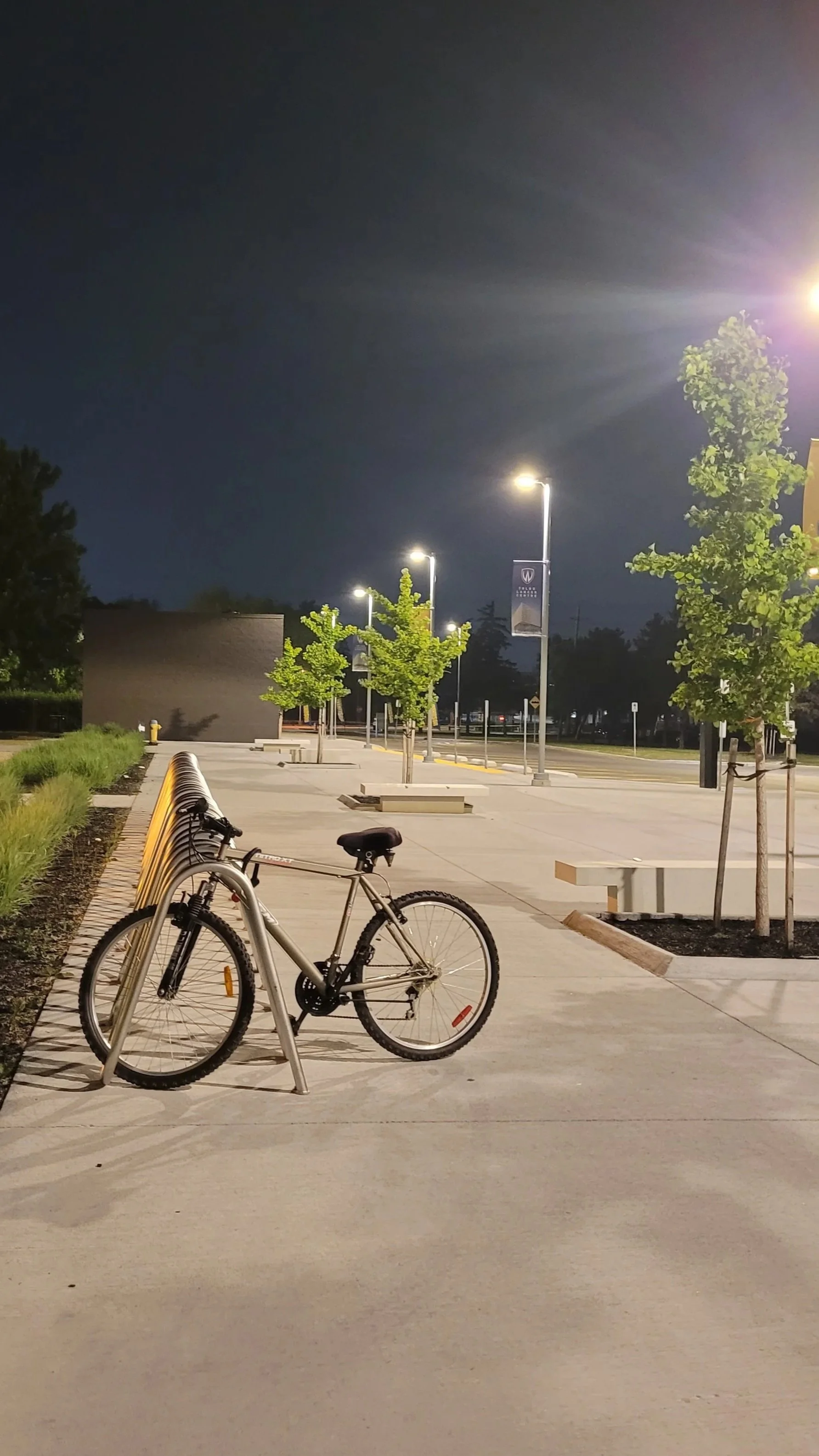
A bicycle parked outside the Toldo Lancer Centre at its dedicated locking stations.
Despite abundant locking stations present throughout the University and city, bicycle thefts are increasingly common particularly around the Spring and Summer months. The Toldo Lancer Centre frequantly reports incidences of patrons being subjected to bicycle thefts whilst visiting the recreation centre. Thefts are not limited to bicycles, even electric scooters are common targets.
A good practice is to utilize both a U-lock and a reinforced cable cord. If locking against an immovable object take precaution that it is suitable for the job. It must be tall enough to prevent a thief from looping the cable over the end vertically, and strong enough to prevent removal. Common choices are dedicated locking posts provided by your city. Ensure the U-lock jams one of your wheels and is secured against your frame. Use the cable to wrap around the other wheel and locking post. If no locking post is available for a short stop, ensure you lock your wheels to the bicycle frame with the U-lock serving as the barricade. This prevents the bicycle from moving even if detached from a stationary post.
Your goal is to make your bicycle as unattractive to thieves as possible.
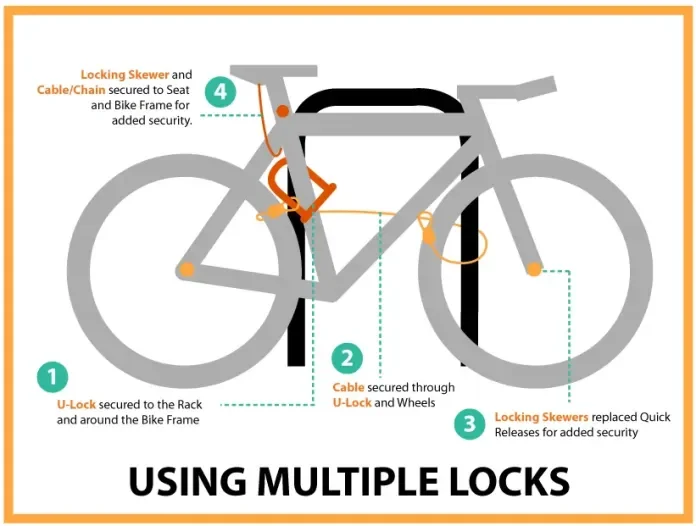
Illustration from:
The final step you can take if you own a bicycle is to register your serial number with Windsor Police’s bicycle registry. This ensures that your bicycle is attached to your identity at all times.
Apart from daily travel, cyclists near the University can enjoy a variety of trails at Malden Park, Ojibway national park, and of course the riverfront to name a few. Whilst parts of Windsor offers cyclists dedicated lanes, the city, much like many other parts of Ontario does not fully facilitate a cycling lifestyle. The urban infrastructure clearly prioritizes motor traffic over healthier, more economical, and sustainable alternatives such as walking, bussing, and of course, cycling.
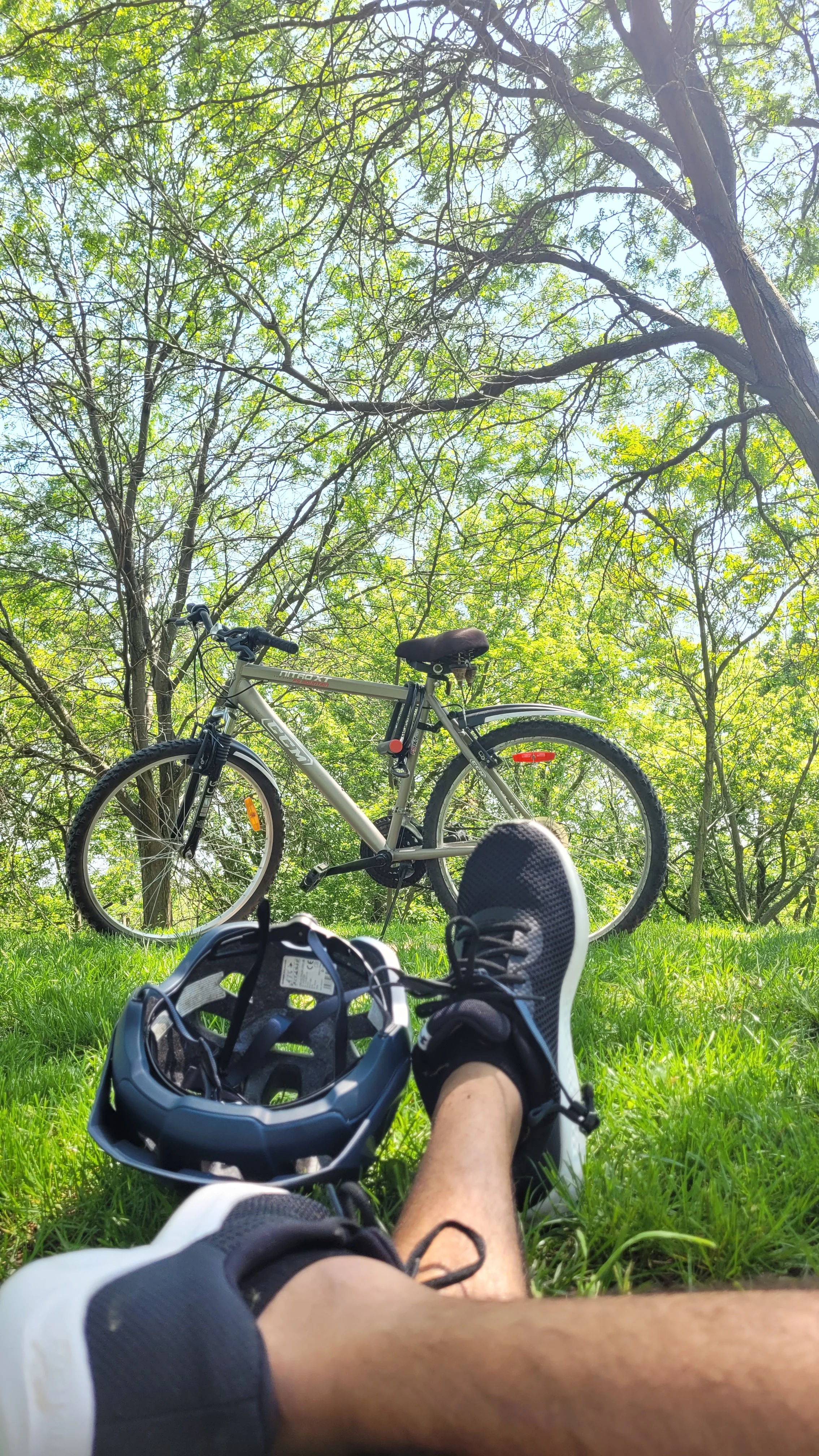
A quick stop at Malden park
Ultimately, the bicycle, despite being a revolutionary invention with periodic changes until its final ubiquitous form around the world faces a challenge no designer or innovator can solve – a system that overlooks its practicality and necessity.
