
UWindsor Alumni making waves in Forensic Science alongside man’s best friend
Cover photo taken from National Geographic Education Blog.
Forensic science is the application of scientific mechanisms used to investigate physical evidence. It has been crucial to solving crimes for decades due to the unequivocable proof that it provides. Fingerprinting, DNA analysis, and many other methods have been the sole providers of justice for many years, and now our techniques are expanding.
Madison Leung, a UWindsor alumnus who now works at the Centre of Forensic Science, has recently been contributing to these methods through her work with Human Remains Detection (HRD) dogs. These dogs have heightened olfactory senses that have the unique ability to uncover human remains. They use their heightened sense of smell to identify the specific volatile organic compounds (VOCs) that appear during the decomposition process.
This research has also uncovered some limitations to the dogs’ abilities, specifically surrounding situations in which the matter is buried. The problem arises when the dogs have trouble sensing the VOCs, as it takes more time for them to reach the surface where they may be detected.
To truly understand the ramifications of this condition, our researcher has conducted a series of tests to understand how the type of soil affects the decomposition of VOCs in these buried remains. Madison achieved this by collecting and analyzing the odor profiles of decomposing remains in three distinct soil types; graveyard clay, peat moss, and graded sand. These soil options were chosen due to the differences in particle size, with peat moss as a natural intermediate. Clay is a soil type known to have the smallest particle size by the USDA, while sand has the largest particle size. Their differences in density and weight are crucial to understanding the limitations of this HRD method.
The results of this research showed that the soil did influence the odor profiles with clay having the strongest VOC intensity and peat moss the lowest. Additionally, the odor profile of sand is best associated with that of decaying matter, due to its larger particle size which accelerates decomposition and allows the VOCs more movement. Leung has completed her work on this project and believes that future researchers will reach the same conclusions and perhaps find something new.
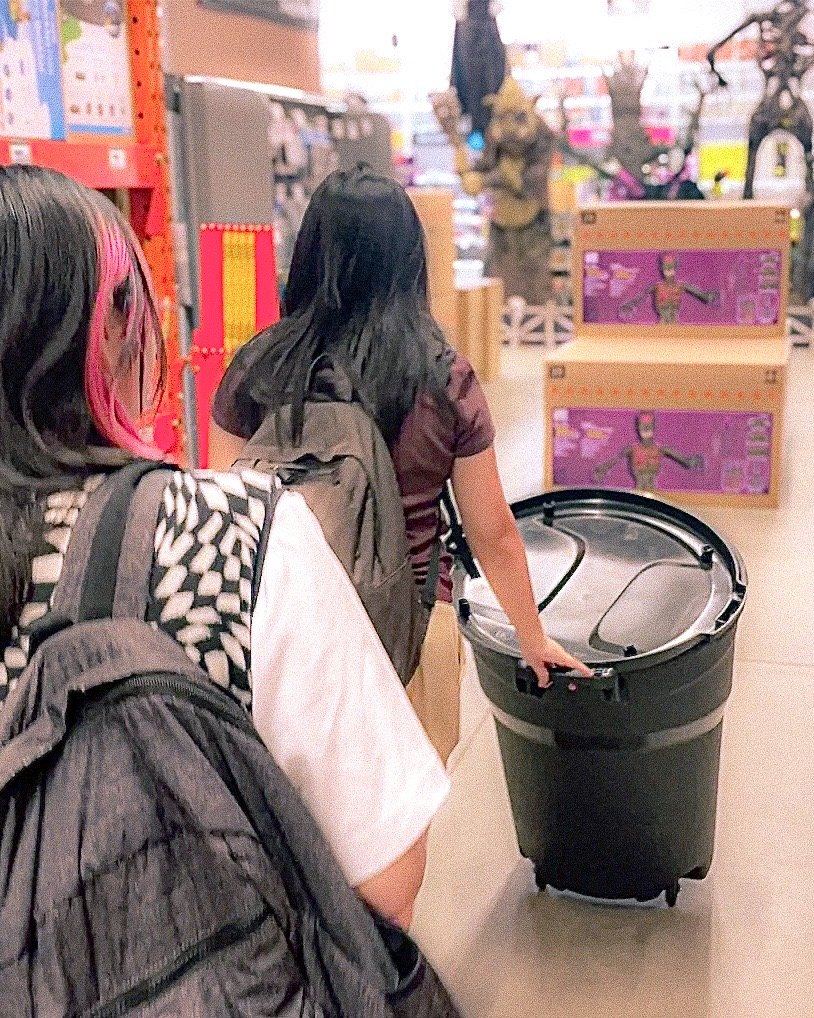
Leung pushes a 32-gallon garbage bin out of Home Depot for use on-site
“Our current political and environmental landscape is one that is incredibly polarizing” states Leung.
Through prominent and ever-growing warfare looming ahead, the recovery of human remains with forensic and emotional value is necessary. The conclusions of this study will no doubt prove useful in the search for missing people, whose remains are often never found, allowing families of the victims to achieve closure. Moreover, a Canada-specific application of these findings mentioned by Leung is the uncovering of the remains of Indigenous People, who have suffered years from trauma and lack of resolution.
As an avid scientist, Leung described the research process as a blend of several subjects, saying that, “Although we often separate the arts and the sciences from each other, scientific research is not so far different from the creative process. We start with a question and construct a story surrounding the data that we gather over time. It’s an odd dance, really, trying to strike a logical balance between the two.” Her description is strangely inspiring, as many picture research as overly technical and without life. However, Leung reinvents this career passionately.
Madison Leung graduated from the University of Windsor with a bachelor's degree in forensic chemistry and has been using her degree to the fullest. She loves to read classics, and at heart will always be an artist. This passion is shown through her work, and she is a shining example of the brightest UWindsor has to offer the scientific community.