
Communication Students for Change: The importance of studying the field
As one of the most recent entrants into the world of academia and formal education, communication studies addresses perhaps the most quintessential aspects of history as well as our modern world. A discipline plagued with the demand to evolve and adapt to a rapidly changing media environment driven by politics, capital, and artificial intelligence, the study of communication originated in the United States during the early 20th century. The work of historic scholars such as Walter Lippman, Harold Lasswell, Paul Lazarsfeld and strategists such as Ivy Lee played an instrumental role in the development of public relations, propaganda, and advertising as a form of public persuasion. However, the studying of communication as a phenomena can be traced back to ancient Greece with the writings of historic minds such as Socrates, Plato, Aristotle, and Aspasia, many of whom battled against each other’s intellect on rhetoric and the art of persuasion. Media thus can be identified as a powerful weapon which can shape culture and politics, but also as a mobilizer of the public for valiant causes.
In an article titled "On the Margins of Margins: #CommunicationSoWhite-Canadain Style” published in the journal of Communication, Culture & Critique, authors Hirji, Jiwani, and McAllister write:
“When looking at the legacy of Innis, Grant, Marshall McLuhan and others, Canadian communication thought is dialectical, holistic, ontological, oriented to political economy, and concerned with mediation”.
The authors emphasize that it is in opposition between critical and administrative scholarship. Canadian communication scholars have laid the foundation of the humanitarian and sociological lens of communication studies. Unlike the administrative approach of American institutions, Canadian universities focus on the how and why of media. Marshall McLuhan, one of the most renown scholars in the field spent some of his formulative years at the University of Windsor (then known as Assumption College) between 1944-1946. His contributions include the idea that the medium is the message, the figure and ground lens of communication, the encoding-decoding model, and the four tetrads of new mediums. Another significant scholar, Harold Innis known for recognizing the dynamics of mass communication through time and space-biased media, as well as Dallas Smythe known for developing the concept of audience commodification have all laid the groundwork for analyzing media through the question “how”?
This is demonstrated in the work of UWindsor’s own cohort of graduate scholars. This year, a group of eight graduate students studying UWindsor’s Master of Arts in Communication, Media and Digital Culture tackle various aspects of our modern world with the goal of asking “how” media impacts their respective subjects of research. The students will produce their own major research projects within a year of enrollment under the guidance of a supervisor through the department of Communication, Media and Film. Lacey Mcwilliam offered a glimpse into her project:
“My MRP project asks “how does the Star Wars series Andor use the pop culture space as a platform to draw attention to surveillance as a tool for colonization?” I chose to pursue this project for two reasons. First, because surveillance practices and technologies historically are a means of oppression that have been made a natural part of the contemporary environment, facilitating the accumulation of wealth and power”.
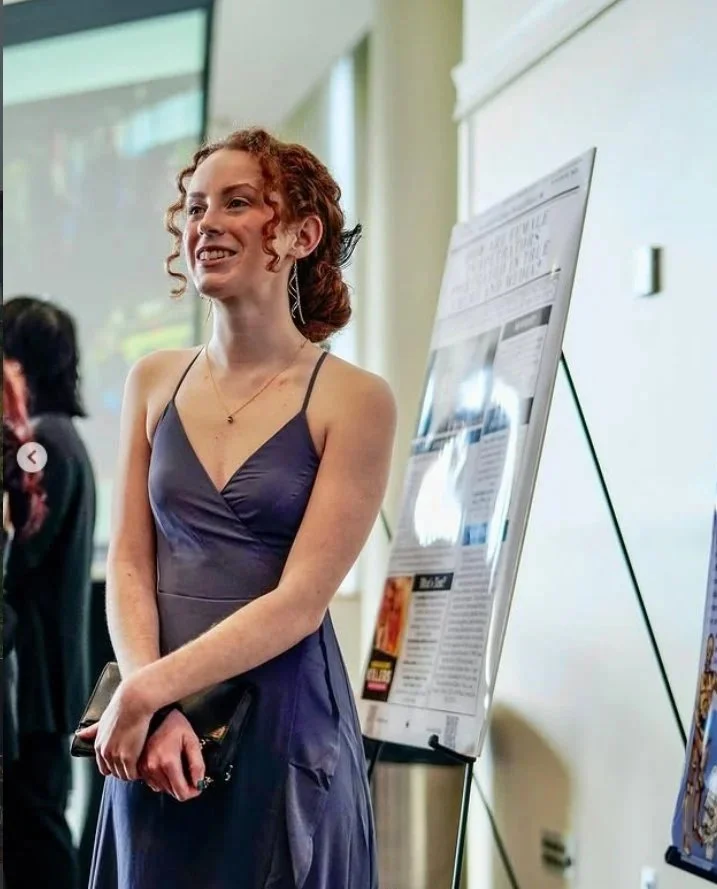
Pictured: Lacey Mcwilliam presenting her undergraduate research at the Communication & Film Students’ Association gala in 2025.
The research subjects being undertaken by the cohort ranges from AI, advertising, political rhetoric, surveillance, news reporting, to even the revival of vinyl records as a medium.
“I am highly interested in understanding how technological advancements have motivated our engagement with analog media, while concurrently playing a role in its decline. Specifically, the methods by which vinyl is showcased through digital media. Its distinctive position at the intersection of the physical and digital offers a foundation for exploring contemporary interests and the intrinsic values embodied within their symbiotic relationship” said Madison Uszynski.
Aidan Billing is looking to provide a service to his local community within the city of Windsor by researching how car advertising keeps the urban infrastructure of cities like Windsor more car-oriented instead of prioritizing public transportation.
“I initially wanted to expand upon my undergrad MRP, which was on the Culture Industry and its relation to the promotion of youth basketball. Still, I pivoted toward car hegemony and the way the city is portrayed in car advertisements,” said Billing.
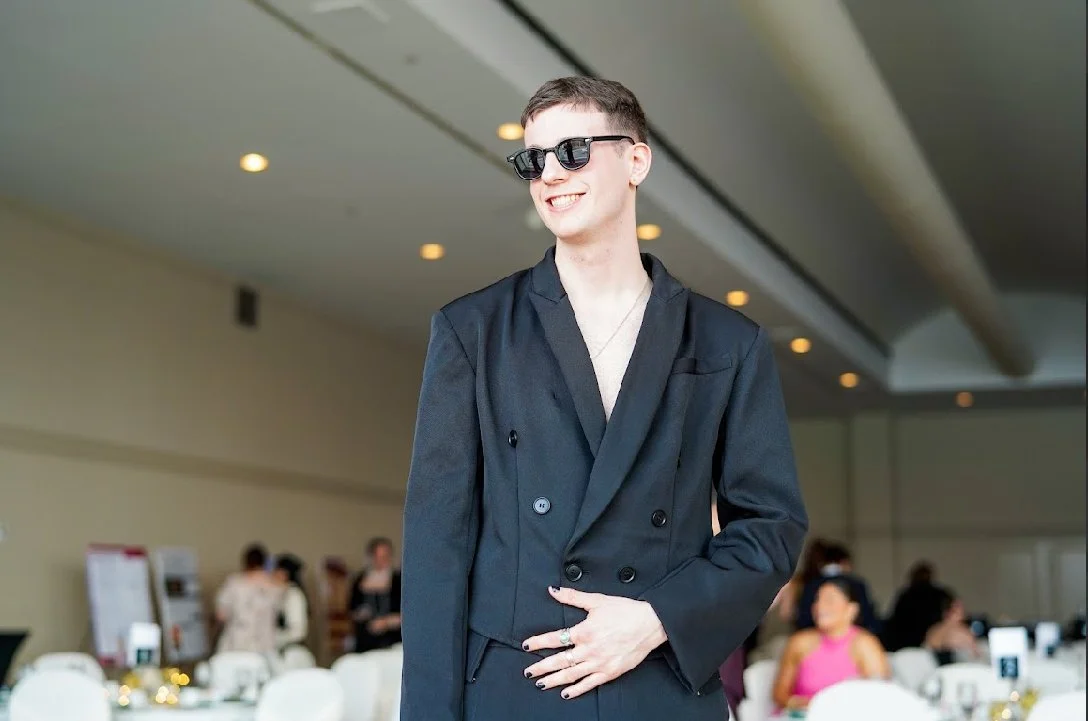
Pictured: Aidan Billing at the Communication & Film Students’ Association gala in 2025
When asked why this project is important, he responded “The great cities of the world have room for both, with a lean towards people, with many cities in North America initially subscribing to this. Why did this change? What continues [the notion] that the car is an important tool for city living instead of a robust network of different modes? We need to understand what car ads show us concerning the urban form that has us so convinced that the city cannot be lived in without a car”.
Research often stems from a deeply personal pursuit for answers or justification. Ian Milne is researching the news reporting of charity and poverty in Canada.
“Since I was a kid, my family has lived below the poverty line; some of my earliest memories are of my mother struggling to put food on the table, living cheque to cheque from child tax benefits and welfare…. I want to know how our news media is presenting these concepts to us, and especially what assumptions it takes for granted and reinforces” Milne shared.
Communication students don’t get enough credit for their dedication to tackle complex research topics with the goal of producing a media-centered approach to understanding them, as well as progressively reshaping industries with public welfare in mind. The terms communication and media can be ambiguous to an unsuspecting individual. The discipline is clouded with a vast history and complex theoretical background. When asked what she wishes people knew about her field, Uszynski said “It is crucial to reflect on and analyze their impact on the cultural zeitgeist. Studying the messages we encounter through critical perspectives helps us gain a deeper understanding of the media we engage with”. Mcwilliam added that she wishes people realized “how wide-reaching [communication studies] is across subjects. One day we could have a seminar about greenwashing in advertising; the next could be about gender representation in news media. It allows for great discussion and a lot of different ideas. Everyone in the graduate program has a research topic that is unique to them and their interests!”
MRP projects from past cohorts are available publicly on the department’s website.
Department Head Dr. Kyle Asquith claims “all social issues are also media issues, because our engagement with social and cultural issues is ultimately mediated through both traditional and legacy media”.
Dr. Asquith has been given the honour of hosting the 46th Canadian Communication Association research conference. Fei Qin is working as the student coordinator of the event through the department’s internship program. This year, the University of Windsor will house the first independently organized conference of this nature. The event will feature award-winning scholars from the field of communication and media studies presenting their research and offer students, faculty and other guests a pivotal networking opportunity. According to Michael Darroch as stated on the website, UWindsor was where the initiative to form Canada’s communication association came to fruition. Nearly half a century later, the history of this rich discipline has come full circle, and what a time in our world to do so.
The conference will be held on the 2nd, 3rd and 4th of June 2026. To stay updated, follow The Lance on Instagram and stay tuned for our exclusive coverage of the event.
